| Specifications | Description | |||
| Power supply | 220 V system input voltage | 1P AC 200 V (-15%) to 240 V (+10%), 50/60 Hz | ||
| 3P AC 200 V (-15%) to 240 V (+10%), 50/60 Hz | ||||
| 400 V system input voltage | 3P AC 380 V (-15%) to 480 V (+10%), 50/60 Hz | |||
| Control mode | IGBT PWM control with sinusoidal current drive | |||
| 220 V and 380 V: single-phase or three-phase full-bridge rectification | ||||
| Ports | Control signal | Input | EtherCAT-based servo drive: 5 DIs | |
| DI1–DI3: standard DIs. Voltage range: 12–24 V. Rising-edge input delay (24 V input transition from low to high): 100 μs. Falling-edge input delay (24 V input transition from high to low): 50 μs. | ||||
| DI4–DI5: High-speed DIs. Voltage range: 12–24 V. Rising-edge input delay (24 V input transition from low to high): 30 μs. Falling-edge input delay (24 V input transition from high to low): 5 μs. | ||||
| Filter time: User-configurable | ||||
| Output | EtherCAT-based servo drive: 2 differential DOs (functions configurable via the corresponding parameters) | |||
| Voltage range: 5–30 V | ||||
| Output turn-on delay: 5 μs | ||||
| Filter time: User-configurable | ||||
| Max. output current: 50 mA | ||||
| Analog signal | Input | 2 channels, 16-bit resolution, max. allowable input range: ±10 V | ||
| Pulse signal | Output | 4 outputs (3 differential outputs and 1 Z-phase open-collector output) | ||
| First encoder | Input | Supports up to 26-bit multi-turn absolute encoders and functional safety encoders. | ||
| Supports 2-wire and 4-wire absolute encoder interfaces (Tamagawa, BiSS-C, and EnDat 2.2). | ||||
| Max. baud rates supported by absolute encoders: Tamagawa: 5 Mbps; BiSS-C: 10 Mbps; EnDat 2.2: 16 Mbps. | ||||
| Second encoder | Input | Supports differential ABZ incremental signals (up to 20 MHz after multiplication), BiSS-C, EnDat 2.2, SSI, and Hall signals (single-ended by default). | ||
| Communication | USB | Communication with host computer software (standard USB 2.0, Type-C); Full-Speed; communication rate: 12 Mbps. Supports parameter commissioning and programming when powered directly via USB. | ||
| EtherCAT | 1:n communication (optional) | |||
| Safety terminal | STO | Standard (meets SIL 3 certification requirements) | ||
| Brake terminal | BRK | Standard, 24 V brake current < 3 A | ||
| PTC | Temperature feedback | Supports PT100, PT1000, and KTY84 | ||
| Gantry synchronization interface | Feedback | First encoder interface | ||
| Control mode | EtherCAT model control modes: Cyclic synchronous position (CSP), cyclic synchronous velocity (CSV), cyclic synchronous torque (CST), profile position (PP), profile velocity (PV), profile torque (PT), and homing (HM). | |||
| Standard functions | ||||
| Position control | Control input | For network-type models, commands are provided via EtherCAT communication. Supports local multi-step position setting (up to 64 groups of point-to-point control). | ||
| Control performance | Positioning time: 1 ms–10 ms | |||
| Digital input signal function selection | 5 DIs. DI1–DI3: standard DIs; DI4–DI5: high-speed DIs | |||
| Default functions: DI1: POT (positive limit); DI2: NOT (negative limit); DI3: Home switch; DI4: Touch probe 1; DI5: Touch probe 2. Default logic: Normally open (NO). | ||||
| Digital output signal function selection | 2 DOs | |||
| Default functions: DO1: RDY (servo ready); DO2: ALM (servo alarm output). | ||||
| Pulse output | The signal source can be either the motor encoder or a pulse input. Pulse output is supported via either the first encoder interface (A+/A-, B+/B-) or the second encoder interface (A+/A-, B+/B-, Z+/Z-). | |||
| Supports output polarity selection for forward and reverse directions, selectable A-leading or B-leading phase, and configurable Z-pulse width and Z-pulse offset. | ||||
| Speed control | Speed command input | Internal speed command selection 1, internal speed command selection 2, internal speed command selection 3, zero-speed clamp, and analog input. | ||
| EtherCAT communication modes: CSV mode and PV mode. | ||||
| Analog reference, high-resolution internal speed (P6.02), and internally calculated speed (P6.03, P6.10). | ||||
| Speed loop bandwidth | 3.5 kHz | |||
| Internal speed command | 8 internal speeds can be selected via external control inputs. | |||
| Acceleration (ACC) / Deceleration (DEC) adjustment | ACC/DEC times can be set separately. S-curve ACC/DEC can also be configured. | |||
| Torque control | Torque command input | Commands are provided via EtherCAT communication for network-type models. | ||
| EtherCAT communication modes: CST mode and PT mode. | ||||
| Analog reference, internal torque command (P7.02). | ||||
| Torque control accuracy | Torque control accuracy: ±1% (when equipped with our IMS20B motor). | |||
| Speed limit | Speed limit can be set via parameters. | |||
| Advanced functions | ||||
| PTP control | 64-point fixed position control; speed, acceleration/deceleration, and execution functions for each group can be set individually. | |||
| Point setting | Supports combined control through multi-point curve planning. | |||
| Homing | Supports 35 homing methods specified by the CiA standard and hard-stop homing. | |||
| Electronic cam | Supports manual cam table creation, S-curve, flying shear, and chasing shear functions, as well as combined control based on multi-cam curve planning. | |||
| Position compare output | Supports 40-point position compare output, including single, multiple, and cyclic comparisons. | |||
| Touch probe function | Supports 2 channels of touch probes, capable of recording the position information at the rising and falling edges of the touch probe signal. | |||
| Gantry synchronization | Includes rigid gantry, flexible gantry, alignment, and homing functions. Supports inter-drive communication. | |||
| Backlash compensation | Supports compensation calculation based on the backlash, the axis movement direction and the measured actual value entered through parameters. | |||
| Pressure control | Pressure sensor analog signals are connected to the drive to realize the pressure control process including fast approach, detection, press-fitting, pressure holding, and retraction. | |||
| Fully closed-loop control | Supports fully closed-loop control using external encoders that support AB quadrature pulse signals or the BiSS, EnDat 2.2, and SSI protocols. | |||
| Gravity compensation | During brake release, the drive compensates for gravity-induced torque variations on the vertical axis by adjusting the motor output torque, thereby eliminating or significantly reducing the drop distance. | |||
| Collision detection | Supports collision detection with configurable response actions. | |||
| Positioning compensation | Supports up to 1024-point positioning compensation. | |||
| Electronic nameplate | Supports the electronic nameplate function when used with compatible motor encoders. | |||
| Cogging torque compensation | Supports the cogging torque compensation function. | |||
| Tuning function | Supports single-parameter auto-tuning, one-click auto-tuning, and online auto-tuning. | |||
| Other functions | Supports voice coil motors, motor thermal model protection, and remote commissioning via IoT modules. | |||
| Protection | ||||
| Protection functions | Overcurrent protection, overvoltage protection, phase loss protection, undervoltage protection, overload protection, overspeed protection, heatsink overheat protection, encoder error protection, and encoder disconnection (ABZ disconnection) protection. | |||
| Dynamic braking | Used for emergency stop function. | |||
| Stop mode | Supports coast to stop, zero-speed stop, ramp stop, quick torque stop, and dynamic braking stop. Stop methods are configurable. | |||
| LED display | Main power Charge indicator, 6-digit LED display (white segment display). | |||
| Protection and fault records | Records the most recent 10 alarms (with timestamps). Supports black box functions. | |||
| Other | ||||
| Functional safety* | The STO safety function is integrated into the servo drive, while SBC, SS1, SS2, SLS, SDI, SOS, and SSM are implemented via an optional functional safety expansion card. Supports functional safety protection triggered by I/O and FSoE. | |||
| Certification* | Meets the requirements for CE, SIL 3 safety certification, UL, KC, UKCA, EAC, SEMI F47, and EtherCAT conformance certification. | |||
Popular Searches:

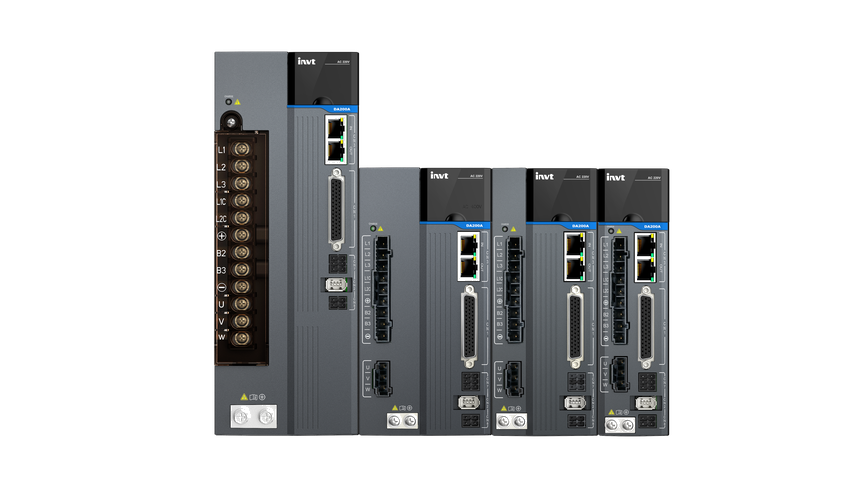
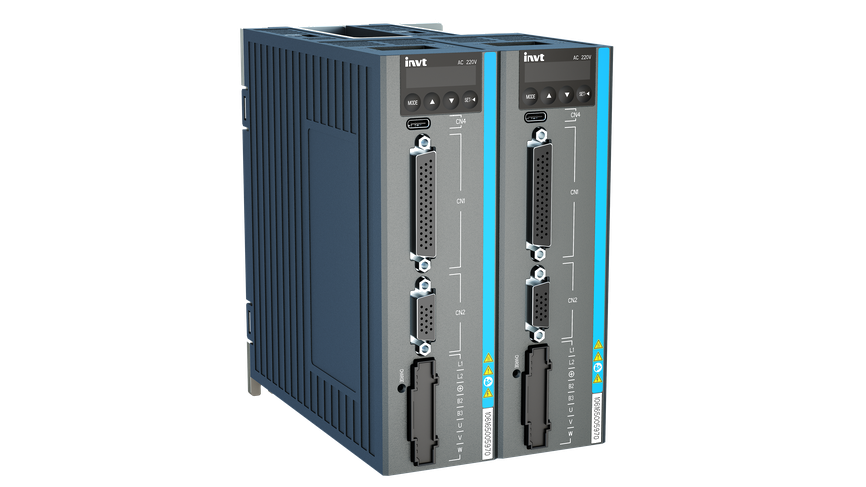
DA360 Series AC Servo Drives
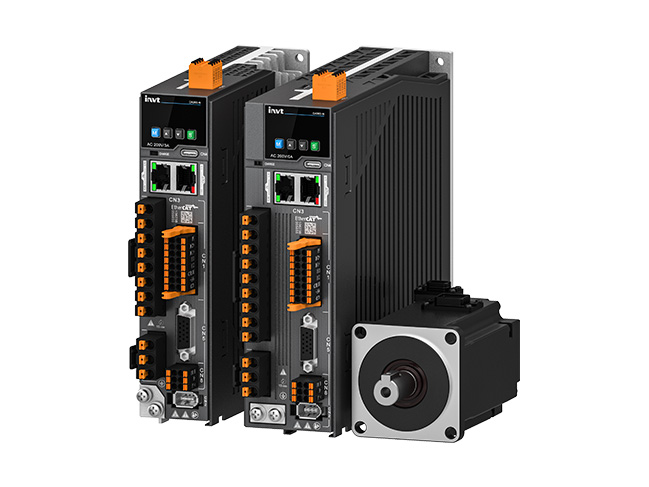
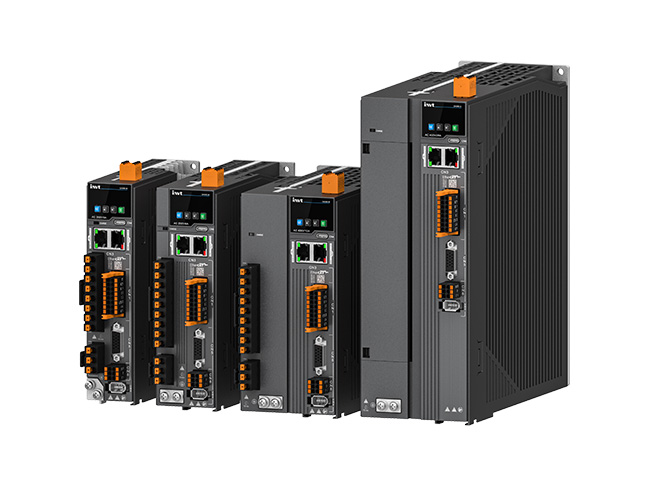
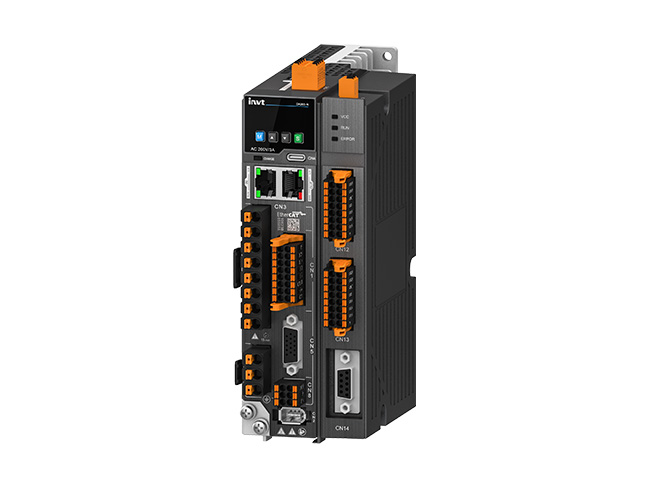
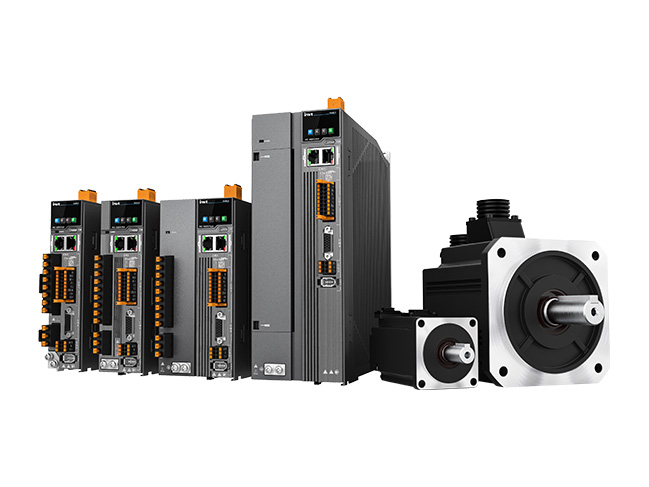
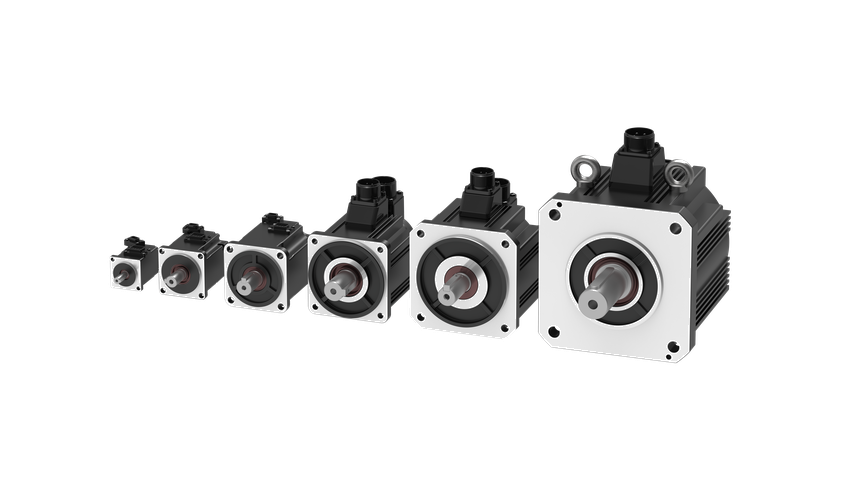
The DA360 series represents INVT's new generation of servo drives. It combines high-speed control algorithms with a highly robust hardware design, delivering a speed-loop bandwidth of up to 3.5 kHz. It supports motors with 26-bit absolute encoders and is compatible with direct-drive linear motors (DDL), direct-drive rotary motors (DDR), and voice coil motors. The series features advanced built-in functions, including gantry synchronization, pressure control, and flying trigger. It also supports one-click auto-tuning and comes standard with STO, with optional expansion to support safety functions including SS1, SS2, SOS, SSM, SBC, SDI, and SLS. It meets the requirements for SIL 3, the highest safety level for drive safety functions, and supports Safety over EtherCAT (FSoE). It also complies with the applicable CE, UL, KC, and SEMI F47 requirements. These capabilities help drive key technological breakthroughs at critical process stations in high-end equipment used in the lithium battery, semiconductor, and precision machine tool industries.
·0.2–7.5 kW
·AC 220 V/380 V
·SIL 3 safety certification


 Images
Overview
Features
Specifications
Downloads
More Resources
客户案例
相关视频
更多支持
Features

High performance
 Delivers a speed-loop bandwidth of 3.5 kHz, a min. EtherCAT communication cycle of 62.5 μs, a max. speed of 7,000 rpm, and a 3.5× overload capacity. Supports 26-bit optical encoders and 23-bit battery-free mechanical multi-turn absolute encoders.
01
Advanced safety
STO comes standard, with optional expansion to support safety functions including SS1, SS2, SOS, SSM, SBC, SDI, and SLS. Meets SIL 3 requirements, the highest safety level for drive safety functions, and supports FSoE, helping establish a system-level safety architecture.02
Integrated functionality
Standard features include built-in brake control and motor temperature monitoring. The drive is compatible with linear motors, DD motors, and voice coil motors, and supports multiple communication protocols. It also integrates advanced process algorithms, including gantry synchronization and pressure control, to make complex applications easier to implement and operate.03
Smart and easy to use
Features one-click auto-tuning, full-frequency vibration suppression, and various parameter compensation functions, significantly lowering the barrier to commissioning and enabling plug-and-play operation.04
Precision engineering
Its highly robust design greatly enhances immunity to interference and adaptability to environmental conditions, ensuring stable operation with cables up to 50 m long. The ultra-slim, book-style design supports seamless side-by-side installation, thereby saving installation space.05
Comprehensive certifications and compliance
The product is undergoing certification and compliance assessments for CE, UL, EAC, KC, functional safety, and SEMI F47, supporting the global market access of the equipment.Note: The certifications listed above are currently in progress.06
Specifications
Downloads
By Type:
 Load More
Have questions or need support?
Our professional team is here to help.


Inquiry
TOP
Popular Searches:
Repair Progress Tracking | Identity Verification
To protect your repair information, please verify using the mobile number reserved on the service order.
Verify with the reserved mobile number
Verify
SMS Verification Code *
If you cannot receive the code, please contact the after-sales hotline. 400-700-9997


Contact INVT
Get in touch with INVT. Our team will get back to you shortly.
Full Name *
Company Name *
Email Address *
Phone Number *
Country *
City
Inquiry Type *
Product Category *
Select the product you're interested in.
-
Industrial Automation
-
Network Power
-
PV & ESS
-
e-Mobility
Your Message / Requirements *
I have read and agree to INVT Privacy Policy and Terms of Use
Captcha *