Popular Searches:

INVT GD290 VFD for Brick Extruder Drive System Retrofit in Vietnam


Abstract: To address problems such as the original drive system of the brick extruder using star-delta starting and constant-speed operation at grid frequency, and the motor still idling at about 50 Hz when the AMAJA unit (commonly understood on site as a clutch/clutch device) disengages the drive, resulting in severe mechanical wear, INVT GD290 series VFDs were used for upgrade and retrofit. The project configured GD290-400G-4 (400 kW) and GD290-280G-4 (280 kW) VFDs, replacing the original star-delta starting method with VFDs to achieve flexible motor speed regulation according to process requirements. After the retrofit, when the AMAJA disengages the drive, the motor speed can be reduced from about 50 Hz to 20–25 Hz; when the AMAJA engages, the VFD regulates the motor speed according to production requirements. This effectively reduces mechanical wear during engagement/disengagement and improves the system automation level and operation stability.
Keywords: brick extruder; variable frequency speed regulation; GD290; star-delta starting; clutch; mechanical wear
1. Introduction
The customer's original brick extruder motor drive system used star-delta (Y/Δ) starting. The motor is connected to or disconnected from the die head through the AMAJA unit. On site, the AMAJA unit can be commonly understood as a clutch or clutch device, and its function is to control the power connection and disconnection between the motor and the die head.
Before the upgrade, when the AMAJA disengaged the drive (motor separated from the die head), the motor still ran continuously at a grid frequency of about 50 Hz; when the AMAJA engaged the drive, the motor also ran at a fixed grid frequency. This operation mode not only caused energy waste but also aggravated mechanical wear during AMAJA engagement/disengagement.
To improve the above problems, the project used INVT GD290 series VFDs to upgrade the brick extruder drive system, replacing star-delta starting with VFDs, so that the motor speed can be flexibly adjusted according to actual production requirements, and the motor speed can be reduced when the AMAJA disengages the drive, thereby reducing ineffective high-speed operation and mechanical wear.
2. System Equipment Control Requirements
2.1 Load Operation Control Requirements
The brick extruder is a heavy-duty, constant-torque load with high starting resistance and frequent load fluctuations. The VFD is required to have good low-frequency output capability and operation stability, avoid problems such as locked rotor and slipping, and ensure continuous and stable brick extrusion. The site adopts V/F control mode and optimizes starting and low-speed operation performance through parameters such as torque boost.
2.2 Process Control Requirements
The system needs to flexibly adjust the motor speed according to actual operating conditions:
When the AMAJA disengages the drive, the motor is reduced from the original grid frequency of about 50 Hz to 20–25 Hz;
When the AMAJA engages the drive, the VFD controls the motor speed according to production requirements;
The speed reference is given through AI1 analog input;
Forward operation and multi-speed selection are realized through control terminals.
2.3 Equipment Safety and Protection Requirements
The brick factory site has high dust, high humidity, and possible grid fluctuations. The VFD is required to have comprehensive protection functions such as overload, overcurrent, overvoltage, undervoltage, overheating, stall, and locked rotor, to ensure long-term continuous operation of the equipment and reduce fault downtime.
3. Equipment Information and Introduction to INVT GD290 Products
The main equipment of the project is as follows:
Table 1 Equipment Information
| No. | Equipment | Model/Specification | Quantity | Remarks |
|---|---|---|---|---|
| 1 | VFD | INVT GD290-400G-4 | 1 unit | 400 kW |
| 2 | VFD | INVT GD290-280G-4 | 3 units | 280 kW |
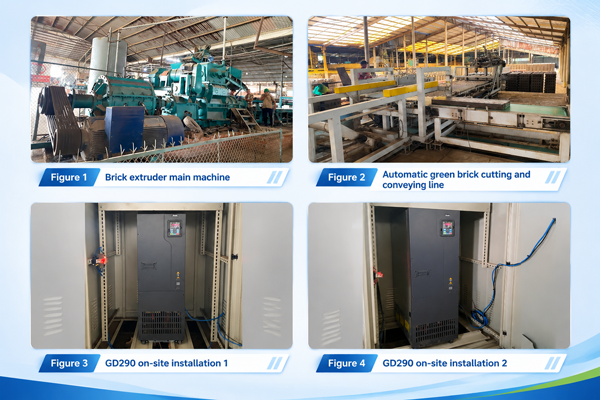
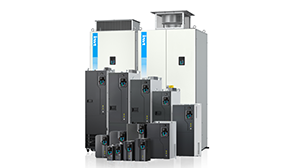
The on-site motors are three-phase induction motors, mainly including 385 kW, 250 kW, and other specifications. The VFD cabinet adopts the INVT GD290 VFD cabinet. The on-site installation is shown in the installation drawings.
The INVT GD290 series VFD is designed for heavy-duty industrial applications. It supports V/F control, terminal control, analog speed regulation, and multi-speed functions. It has good low-frequency torque output capability, comprehensive protection functions, and environmental adaptability, and is suitable for brick extruders, fans, pumps, and other heavy-duty industrial equipment. This project adopts GD290 series 400 kW and 280 kW VFDs to meet the requirements of heavy-duty starting and on-demand speed regulation of the brick extruder.
4. System Commissioning and Effect Description
4.1 Main Parameter Settings
The main on-site parameter settings are as follows:
Table 2 VFD Parameter Setting Table
| Parameter | Value | Unit | Description |
|---|---|---|---|
| P00.00 | 2 | — | V/F control mode |
| P00.01 | 1 | — | Run/stop command source: control terminal |
| P00.03 | 50.00 | Hz | Maximum frequency |
| P00.04 | 50.00 | Hz | Upper frequency limit |
| P00.05 | 0.00 | Hz | Lower frequency limit |
| P00.06 | 1 | — | Speed reference: AI1 analog input |
| P00.11 | 40 | s | Acceleration time: 0 Hz to maximum frequency |
| P00.12 | 40 | s | Deceleration time: maximum frequency to 0 Hz, dynamic braking |
| P04.01 | 2.0 | % | Torque boost |
| P05.01 | 1 | — | S1 terminal function: forward run |
| P05.02 | 16 | — | S2 terminal function: multi-speed selection |
| P10.04 | 40 | % | Running frequency when AMAJA disengages, corresponding to 20 Hz at 50 Hz |
| P02.00 | 0 | — | Motor type: asynchronous motor |
| P02.01–P02.05 | According to motor nameplate | — | Rated power, frequency, number of poles, voltage, current |
Among them, P10.04 is set to 40%, which corresponds to 20 Hz at a maximum frequency of 50 Hz. Combined with the on-site process, when the AMAJA disengages the drive, the motor can be reduced to 20–25 Hz.
4.2 Application Effects
A. Improved process adaptability
After the retrofit, when the AMAJA disengages the drive, the motor no longer runs at a fixed 50 Hz but is reduced to 20–25 Hz, reducing ineffective high-speed operation; when the AMAJA engages the drive, the VFD regulates the speed according to production requirements, making the brick extruder operation more flexible and adaptable to different working conditions.
B. Reduced mechanical wear
Through VFD soft start, soft stop, and 40 s acceleration/deceleration settings, the instantaneous high current and mechanical impact during grid-frequency starting are reduced, and the wear of the motor, bearings, reducer, and AMAJA unit during engagement/disengagement is reduced, which is conducive to extending equipment life.
C. Improved automation level
The VFD adopts control terminal start/stop, AI1 analog speed reference, and multi-speed control, which is convenient for connection with the original control system, reduces manual intervention, and improves operational consistency and production stability.
D. Enhanced operation stability and safety
The GD290 VFD has comprehensive protection functions and can handle abnormal conditions such as overload, overcurrent, overvoltage, undervoltage, overheating, stall, and locked rotor. It adapts to the dust, humidity, and grid fluctuation environment of the brick factory, ensuring continuous and stable operation of the brick extruder.
5. Conclusion
This project uses INVT GD290 series 400 kW and 280 kW VFDs to upgrade the original star-delta starting system of the brick extruder. After the retrofit, the system replaces star-delta starting with VFDs, achieving flexible speed regulation according to process requirements. When the AMAJA disengages the drive, the motor speed is reduced to 20–25 Hz, effectively reducing mechanical wear during AMAJA engagement/disengagement and improving equipment operation stability and automation level. This solution provides a referable application experience for the retrofit of heavy-duty extruder drive systems in the brick and tile industry.


Inquiry
TOP
Popular Searches:
Repair Progress Tracking | Identity Verification
To protect your repair information, please verify using the mobile number reserved on the service order.
Verify with the reserved mobile number
Verify
SMS Verification Code *
If you cannot receive the code, please contact the after-sales hotline. 400-700-9997


Contact INVT
Get in touch with INVT. Our team will get back to you shortly.
Full Name *
Company Name *
Email Address *
Phone Number *
Country *
City
Inquiry Type *
Product Category *
Select the product you're interested in.
-
Industrial Automation
-
Network Power
-
PV & ESS
-
e-Mobility
Your Message / Requirements *
I have read and agree to INVT Privacy Policy and Terms of Use
Captcha *