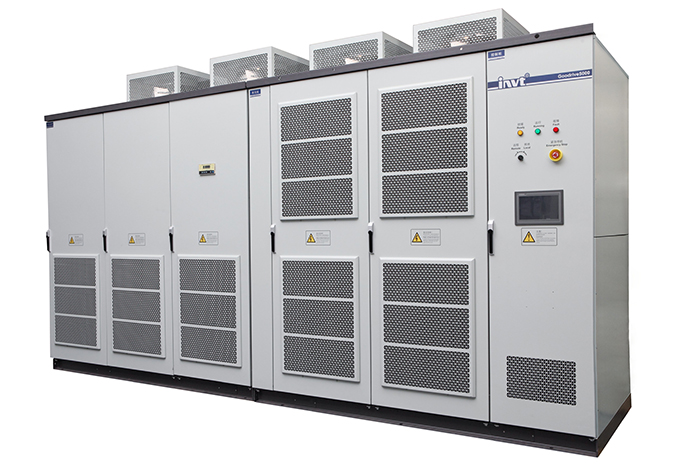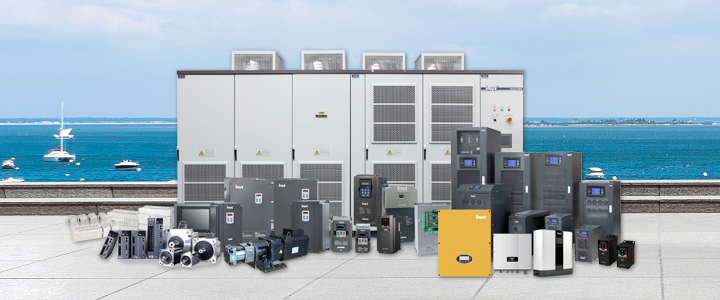
Abstract: The Cement ID fan demand has shifted from simple exhaust capacity to precise pressure control, high energy efficiency, and long-term reliable operation. This paper showed the INVT GD5000 series MVD provides fast response, significant energy savings, reduced mechanical stress for this application.
Keywords: Cement, ID Fan, GD5000 MVD, Compact MVD
I. Project background
The cement ID fan is the core driving equipment of the cement kiln exhaust system. It maintains stable negative pressure throughout the kiln, calciner, and preheater, ensuring stable process operation, efficient combustion, and reliable downstream dust collection.
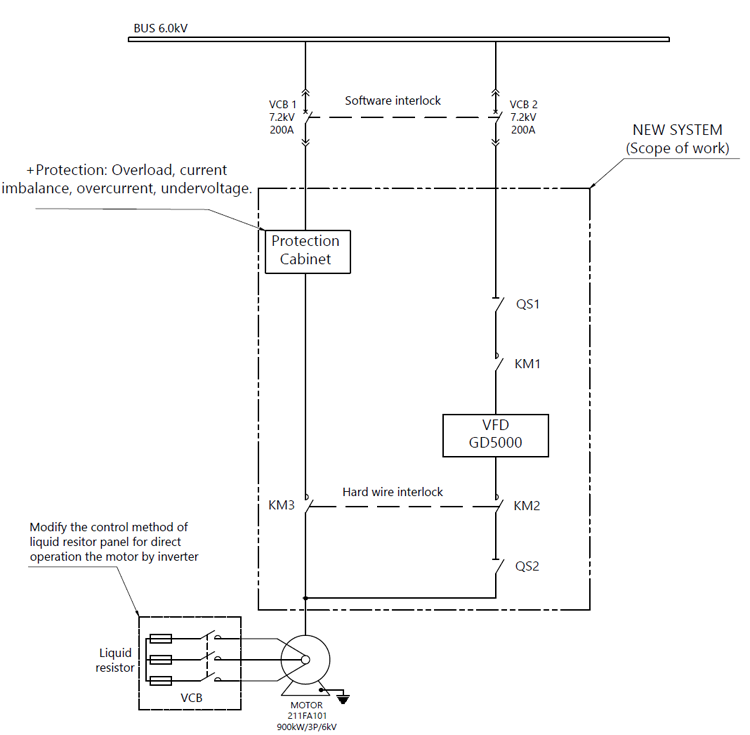
The project is located in a cement plant in Vietnam. The motor is started by the liquid resistor, system diagram is as below.

The old system has many challenges:
* High energy consumption: Fan-type loads follow the cubic law: airflow ∝ speed, power ∝ speed³. Under mains frequency operation, even if only 70% of the airflow is actually needed, the motor still operates at nearly 100% power.
* Startup performance issues: The starting current remains high, causing significant impact on the power grid; the startup time is long and heavily influenced by the state of the liquid resistor; the startup process is uncontrollable and lacks repeatability.
* Outdated operating and control methods: The motor operates at full speed at the power frequency for extended periods, relying on dampers/baffles to regulate airflow, resulting in high energy losses and low system efficiency; it cannot respond quickly to changes in actual airflow.
* Maintenance and reliability issues: The liquid resistor experiences aging, scaling, and corrosion; electrodes and insulation components require frequent maintenance; the start-stop reliability is poor, making it a potential point of failure.
II. Customer requirements
The cement ID fan is the "lungs and heart" of the entire cement system, and the current demands for it are concentrated in the following aspects:
* Stable negative pressure control (the most critical requirement): The control objective has upgraded from "simply being able to extract air" to "precise and controllable."
* Significant pressure to reduce energy consumption (the most realistic current need): The cement ID fan is one of the largest single power-consuming pieces of equipment in a cement plant.
* Adaptability to extremely wide operating condition variations: The actual operating conditions of the kiln ID fan vary greatly, requiring the fan to have a wide adjustment range and fast response capabilities.
* High reliability & low unplanned downtime: High temperature, high dust, and continuous operation. Unplanned kiln shutdowns result in huge losses, requiring minimal maintenance periods and necessitating fault prediction and protection capabilities.
III. INVT Solution
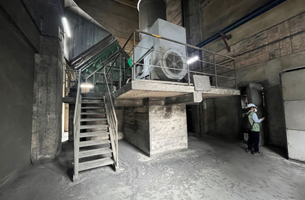
In the factory, the ID fan motor is 900kW, 6kV, 50Hz, 122A, 994rpm.
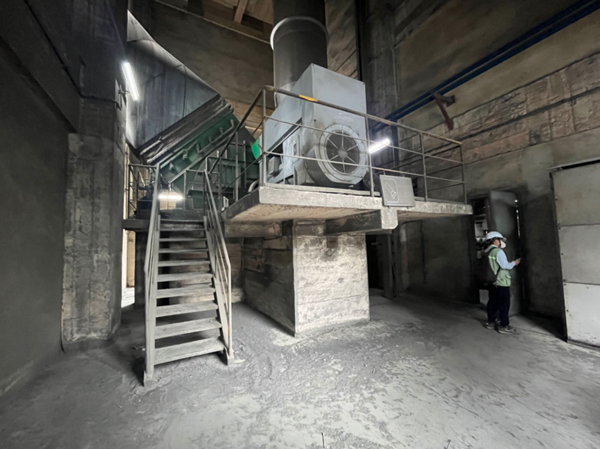
Motor and fan photo
Accroding to the motor rating and customer demand, the configuration is as below table:
| No. | Item | Parameters |
| 1 | Inverter Model | GD5000-A1400-06-L-A7 |
| 2 | Load Type | ID Fan, Asynchronous motor |
| 4 | Rated Capacity | 1400kVA/1120kW |
| 5 | Rated Voltage | 6kV |
| 6 | Rated Current | 135A |
| 7 | Quantity | 1 |
| 8 | System bypass mode | Autobypass |
| 9 | Touchscreen Language | English /Vietnamese |
| 10 | Protection cabinet | KYN cabinet |
And the system schematic diagram is as below:

Solution features
* Full solution of KYN cabinet and MVD
* Profibus-DP communication, fast communicate with DCS, realize speed control, save energy
* Realize soft start, less shock, extend the mechanical system lifetime
* IoT module, remote monitoring
* Multiple pulse rectifier, low harmonics, high efficiency
* Support Vietnamese language
Site photos:
The MVD cabinets and KYN cabinet are installed side by side.
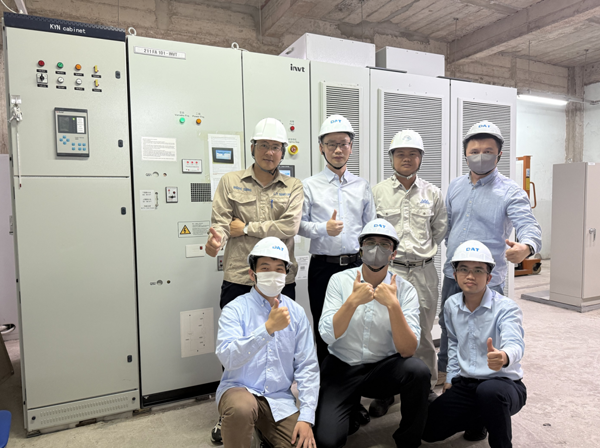
MVD+KYN cabinet
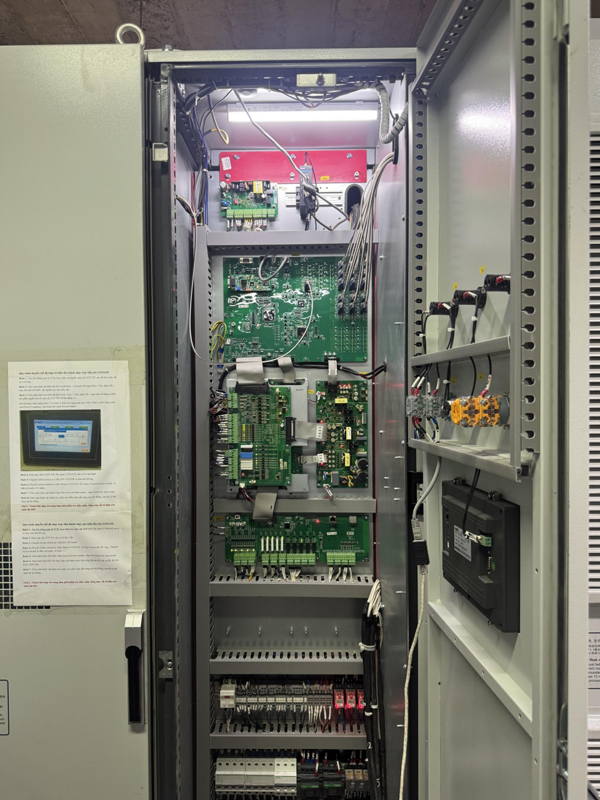
Control panel photo (IOT module at the top)
IV. Customer benifits
* Significant improvements in process control: Fan speed directly regulates airflow, and the kiln tail negative pressure closed-loop control is more precise and stable, responding quickly to changes in operating conditions and improving clinker quality stability.
* Significant energy savings: Regulation is achieved through speed reduction rather than damper throttling, resulting in actual energy savings.
* Safer and more reliable startup and operation: Soft start and zero impact reduce bearing shock, coupling wear, and fan vibration, extending the lifespan of the fan and motor.
* Improved system integration and automation: Seamless integration with DCS is possible, supporting negative pressure PID control, load limiting, fault diagnosis, and trend analysis. This facilitates intelligent control and enables reduced staffing or unmanned operation.
* Reduced operating and maintenance costs: Eliminates the need for water resistance cabinets and their maintenance, reduces spare parts inventory, decreases failure points, and improves system reliability.
* IoT modules enable intelligent control and remote diagnostics\:The MVD provides current, torque, and load trends via IoT, facilitating predictive maintenance and early fault warning.
V. Conclusion
This paper describes the traditional method of starting the system using a liquid resistance starter in conjunction with damper adjustment, which is now unable to meet the requirements of modern cement production in terms of energy efficiency, control accuracy, and reliability. By adopting the INVT GD5000 series MVD for speed control, precise airflow control and stable negative pressure regulation can be achieved. This not only significantly reduces energy consumption but also greatly improves process adaptability, equipment reliability, and automation levels, making it the mainstream direction for technological upgrading of induced draft fan systems in the cement industry.



Our site uses cookies to provide you with a better onsite experience. By continuing to browse the site you are agreeing to our use of cookies in accordance with our Cookie Policy.













 Share
Share
 Facebook
 Twitter
 Google+
 LinkedIn
 Return list