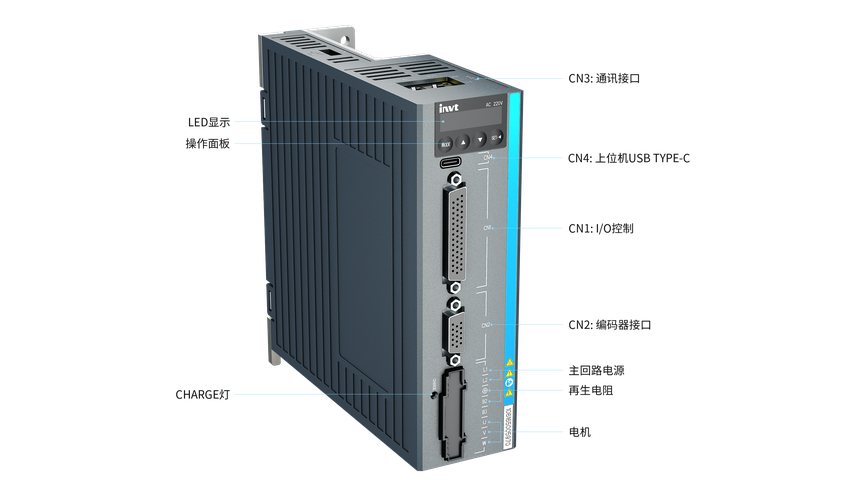
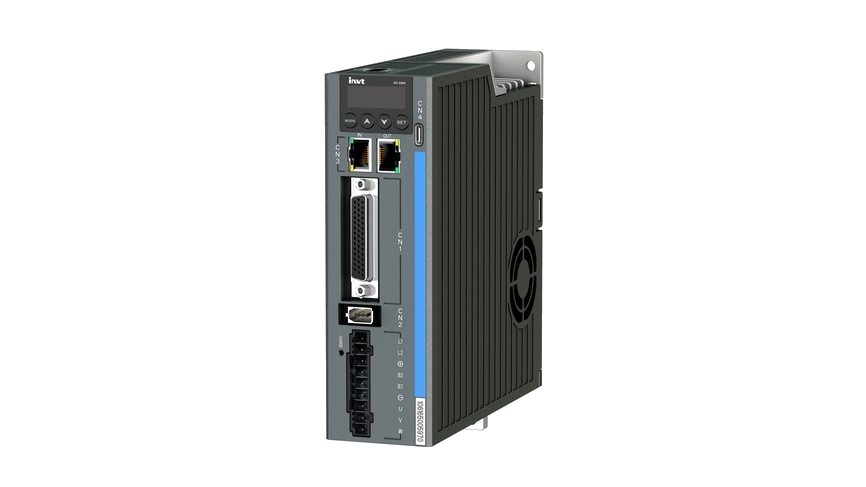
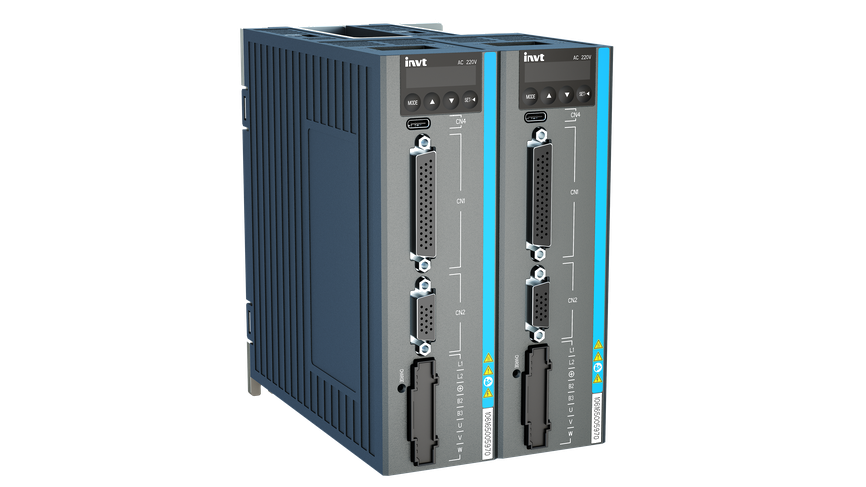
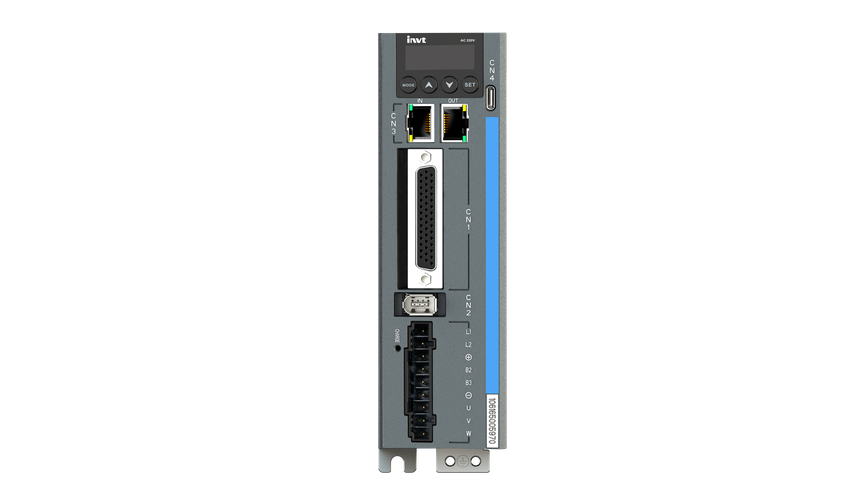
| DA180A series servo drive (400W/1kW) | ||||
| Specifications | Description | |||
| Power supply | System input voltage of 220V | 1PH, AC 220V(±15%), 47–63Hz | ||
Port | Control signal | Input | 10 inputs (The function is configurable through parameter settings.) (7 inputs for EtherCAT models.) | |
| Output | 2/4 differential outputs (The function is configurable through parameter settings.) | |||
| Analog | Input | Two 12bit analog inputs (None for EtherCAT models.) | ||
Pulse signal | Input | Two groups (mode: open collector input or differential input) | ||
| Output | One group differential output (A+, A-; B+, B-; Z+, Z-) One group open collector output (A, B, Z) | |||
| Encoder | Input | 2/4-PPR absolute encoder interface | ||
Communication | USB | 1:1 communication upper PC software | ||
| RS485 | 1:n communication (optional) | |||
| CANopen | 1:n communication (optional) | |||
| EtherCAT | 1:n communication (optional) | |||
| Control mode | 1 Position control; 2 Speed control; 3 Torque control; 4 Position/Speed mode switching; 5 Speed/Torque mode switching; 6 Position/Torque mode switching; 7 CANopen mode; 8 EtherCAT mode | |||
Function | Position control | Control input | 1. Retention pulse clearing; 3. Electronic gear ratio switching; | |
| Control output | Positioning completion output, etc | |||
Pulse input | Max. pulse input frequency | Optical coupling: differential input 4Mpps, open collector input 200kpps; | ||
| Pulse input mode | 1. Pulse + direction; 2. CW+CCW; 3. Quadrature | |||
| Electronic gear (e-gear) | 1/10000–1000 times | |||
| Filter | 1. Command smoothing filter; 2. FIR filter | |||
| Analog input | Torque limit command input | Can independently perform clockwise/counterclockwise torque limit | ||
| Vibration control | Able to suppress 1–200Hz front-end vibration and overall machine vibration | |||
| Pulse output | 1. Can perform arbitrary frequency division settings under the encoder resolution; 2. B phase reverse function | |||
Speed control | Control input | 1. Internal command speed 1; 3. Internal command speed 3; | ||
| Control output | Speed reaching, etc | |||
Analog input | Speed command input | The speed command input can be set according to the analog voltage DC ± 10V | ||
| Torque limit input | Can independently perform clockwise/counterclockwise torque limit | |||
| Internal speed commands | 8 step speed can be switched according to the external control input | |||
ACC/DEC adjustment of speed command | ACC/DEC time setting and S curve setting | |||
| Zero-speed clamp | In the speed mode, it can set the operation mode as the speed mode and position mode | |||
Speed command filter | A delay filter of analog input speed command | |||
Speed command zero drift control | Zero drift control against outside interference | |||
Torque control | Control input | Zero speed clamp input, etc | ||
| Control output | Speed reaching, etc | |||
Analog input | Torque command input | Analog torque command input, gain and polarity can be set based on analog voltage | ||
| Speed limit input | Analog speed limit | |||
| Speed limit | Set the speed limit by parameters | |||
Torque command filter | A delay filter of analog input torque command | |||
Torque command zero drift control | Zero drift control against outside interference | |||
Internal position plan | Plan bits | 128 bits internal position planning, the positioning can be controlled through communication | ||
| Route setting | 1. Position; 2. Speed; 3. ACC time; 4. DEC time; 5. Stop timer; 6. Various state output; 7. Operational mode | |||
| Homing | 1. LS signal; 2. Z phase signal; 3. LS signal+Z phase signal; 4. Torque limit signal | |||
Protection | Protection function | Such as protection against phase-loss, overvoltage, undervoltage, overcurrent, overheating, storage fault, initialization fault, I/O distribution abnormalities and large position deviation, braking resistor overload, and drive overload. | ||
| Dynamic braking | For emergency stop function, including stop and fault stop scenarios. | |||
| Protection and fault record | 1. Up to 10 faults can be recorded. 2. The key parameters can be recorded when fault occurs. | |||
Environment | Working temperature | 0–55°C (Derate 80% when the ambient temperature is 45–55°C.) | ||
| Storage temperature | -20°C–70°C (No freezing) | |||
| Operation/storage humidity | ≤90%RH (no condensation) | |||
| IP rating | IP20 | |||
| Altitude | Lower than 1000m | |||
| Vibration | ≤5.88m/s2, 10–60Hz (Working at the resonance point is not allowed) | |||
Popular Searches:

DA180A Series Basic AC Servo Drives
DA180A series basic AC servo drive, the new generation of INVT simplified single-axis servo product, is utility oriented, making expansion easy. It provides efficient and competitive solutions for the simplification, networking, and high-performance requirements of general-purpose equipment.
·0.4-1KW
·EtherCAT, CANopen, Modbus, PULSE
·CE, EAC, RoHS


 Images
Overview
Features
Specifications
Downloads
More Resources
Case
Videos
More
Features

Rich interfaces
 Supports 3 types of communication buses.Supports 4 types of encoder protocols (other encoder protocols are expandable).
01
Powerful functions
Supports various functions including load inertia identification, EOE, positioning compensation.Wide adaptability with rich functional options.02
Strong power performance
Designed with 3× overload capacity.Supports control of rotary, linear, and torque motors.03
Compact design
45% smaller than the previous generation.Compact and easy to handle with one hand.04
Ease of Use
Supports Type-C debugging interface.Supports one-key parameter auto-tuning, significantly reducing commissioning time.Simple operation for effortless setup.05
Specifications
Downloads
By Type:
 Load More
More Resources







Have questions or need support?
Our professional team is here to help.


Inquiry
TOP
Popular Searches:
Repair Progress Tracking | Identity Verification
To protect your repair information, please verify using the mobile number reserved on the service order.
Verify with the reserved mobile number
Verify
SMS Verification Code *
If you cannot receive the code, please contact the after-sales hotline. 400-700-9997


Contact INVT
Get in touch with INVT. Our team will get back to you shortly.
Full Name *
Company Name *
Email Address *
Phone Number *
Country *
City
Inquiry Type *
Product Category *
Select the product you're interested in.
-
Industrial Automation
-
Network Power
-
PV & ESS
-
e-Mobility
Your Message / Requirements *
I have read and agree to INVT Privacy Policy and Terms of Use
Captcha *