
| Item | Specifications | ||
| Basic parameters | Input voltage | AC 1PH 220V–240V AC 3PH 220V–240V AC 3PH 380V–480V | |
| Input frequency | 50Hz or 60Hz; allowed range: 47–63Hz, with a maximum change rate of 20%/s | ||
| VFD power | 0.2kW–22kW | ||
| Output frequency | 0~599Hz | ||
| Control mode | Space voltage vector control (V/F), and sensorless vector control (SVC) | ||
| Motor type | Asynchronous motor (AM) and permanent magnet synchronous motor (SM) | ||
| Speed ratio | For asynchronous motor (AM), 1:100 (SVC); for synchronous motor (SM), 1:50 (SVC) | ||
| Speed control accuracy | ±0.2%(SVC) | ||
| Speed fluctuation | ±0.3%(SVC) | ||
| Torque response | <10ms(SVC) | ||
| Torque control accuracy | 5%(SVC) | ||
| Starting torque | For AMs: 0.5Hz/200% (SVC) For SMs: 2.5Hz/150% (SVC) | ||
| Overload capacity | Heavy-duty models: 150%/60s, 180%/10s Normal-duty models: 110%/60s, 150%/10s | ||
| Braking unit | Standard built-in braking unit | ||
| Safety function | Standard built-in STO, SIL3 | ||
| Peripheral interface | Analog input | Two analog inputs: AI1: 0–10V/0–20mA AI2: -10–+10V/0–20mA Accuracy: Full-scale accuracy of 1% | |
| Analog output | One analog output AO1: 0–10V/0–20mA Accuracy: Full-scale accuracy of 1% | ||
| Digital input | Four regular inputs; max. frequency: 1kHz One high-speed input; max. frequency: 50kHz Both NPN and PNP are supported, with PNP as the default. DI4 can be switched to provide the PTC function through the toggle switch. | ||
| Digital output | One high-speed digital output; max frequency: 50kHz Optional standard digital output, supporting both PNP and NPN modes. | ||
| Relay output | One programmable relay output RO1A: NO; RO1B: NC; RO1C: common Contact capacity: 3A/AC 250V, 1A/DC 30V | ||
| Type-C interface | It is powered by connecting to a PC through USB, allowing quick parameter viewing and configuration through host controller software without requiring the main power supply. | ||
| Communication interface | RS485 communication, supporting the Modbus RTU communication protocol. | ||
| Keypad display | Five-digit digital tube display, with six keys. | ||
| Expansion card | One expansion card slot: All-in-one communication expansion card: Integrates PROFINET, EtherCAT, EtherNet/IP, and Modbus TCP fieldbus protocols, and allows the communication protocol to be selected by setting parameter P24.00. | ||
| Distinctive functions | ACC/DEC curve setting | Linear type and S-curve. S-curve supports separate settings for ACC and DEC smoothness. | |
| Wobbling frequency function | Specifies back-and-forth frequency wobbling near the center frequency, supports separate settings for rise and fall time, and supports frequency jump. | ||
| Overvoltage stall protection | Automatically adjusts frequency when the voltage exceeds limits to prevent overvoltage tripping. | ||
| Automatic current limiting protection | Automatically limits current and adjusts frequency when current exceeds limits, preventing overcurrent tripping. | ||
| Flexible DO output | Supports output terminal inversion when any function code value exceeds the specified threshold, allowing flexible user application, such as temperature overlimit monitoring, torque reaching, current reaching, voltage reaching, and line speed reaching. | ||
| Flexible AO/HDO output | Outputs any function code value to AO/HDO, allowing flexible user application, such as temperature monitoring, torque monitoring, and PID monitoring. | ||
| IF control | Supports IF control to enhance motor load-starting capability. | ||
| Grid voltage and frequency selection | Supports one-click setting of the VFD input voltage level and frequency. | ||
| Energy-saving control | The VFD automatically seeks the most efficient operating point during actual operation, ensuring the motor operates at its highest efficiency to achieve energy savings, especially for the motor under light load conditions | ||
| Enhanced flux braking | Enhances flux braking to accelerate the motor’s DEC tracking process. | ||
| Inertia identification | Compensates for load inertia and enhances system responsiveness. | ||
| RS485 communication address mapping | Supports user-defined read/write addresses to enhance the flexibility of the RS485 communication. | ||
| Low-voltage commissioning | The VFD can be disconnected from the main power and connected to a PC through the TYPE-C port to modify, save, import, and export parameters. | ||
| Automatic voltage regulation (AVR) | The output voltage can be kept constant although the grid voltage changes. | ||
| Speed tracking | Tracks the actual running frequency and direction, implementing smooth running without impact, and reducing equipment impact. | ||
| Frequency decimal precision setting | The frequency can be set to a value with 1 or 2 decimal places, making it compatible with high-speed motor control. | ||
| Frequency setting method | Supports keypad digital setting, analog setting, multi-step speed running setting, simple PLC setting, PID setting, Modbus communication setting, and so on. These settings can be combined and the setting channels can be switched. | ||
| Fault protection | Provides comprehensive fault protection: overcurrent, overvoltage, undervoltage, overtemperature, overload, phase loss, short circuit, and other protection functions. | ||
| Motor overtemperature protection | Monitors motor temperature in real-time through DI4 (PTC) or AOAI analog combination to reduce the risk of motor overheating damage. | ||
| Environment condition | Application site | Indoors, without direct sunlight, and free from conductive dust, oil mist, corrosive gases, or water vapor. The environment should not contain radioactive, flammable, explosive materials, or salts. | |
| Running temperature | -10℃–+50℃ No derating for normal duty at 40℃ and for heavy duty at 50℃ | ||
| Storage temperature | -20℃–+70℃ | ||
| Transport temperature | -20℃–+70℃ | ||
| Altitude | Star-type grid: Max. altitude of 4000m (13,123ft). Delta-type grid: Max. altitude of 2000m (6,562ft). For altitudes of 1000m (3,281ft) and below, no derating is required. Above 1000m (3,281ft), derate by 1% for every increase of 100m (328.1ft). | ||
| Humidity | <95%RH, no condensation | ||
| Vibration | <0.6g | ||
| Overvoltage category | OVC Ⅲ | ||
| Pollution level | 3C2,3S2,PD2 | ||
| Ingress protection (IP) rating | IP20 | ||
| EMC class | The built-in C3 filter (10m) is standard for requirement meeting, while the optional external EMI filter can be selected to meet C2 class requirements. | ||
| Product certification | UL, CE, and TUV | ||
| Mounting method | Wall mounting, DIN rail mounting, and flange mounting | ||
| Cooling method | 220V voltage class: Natural cooling for 0.75kW and lower 380V voltage class: Natural cooling for 1.1kW and lower Others: Forced air cooling | ||
Popular Searches:

GD28 Series Flexible General-Purpose VFD
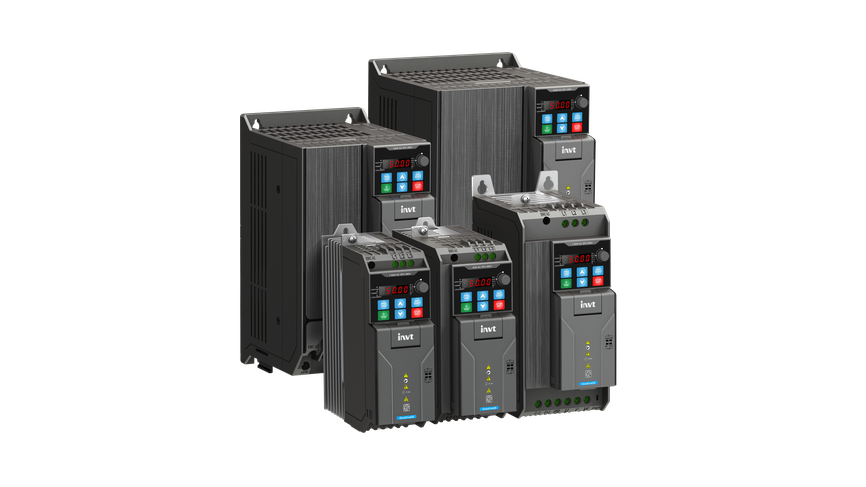
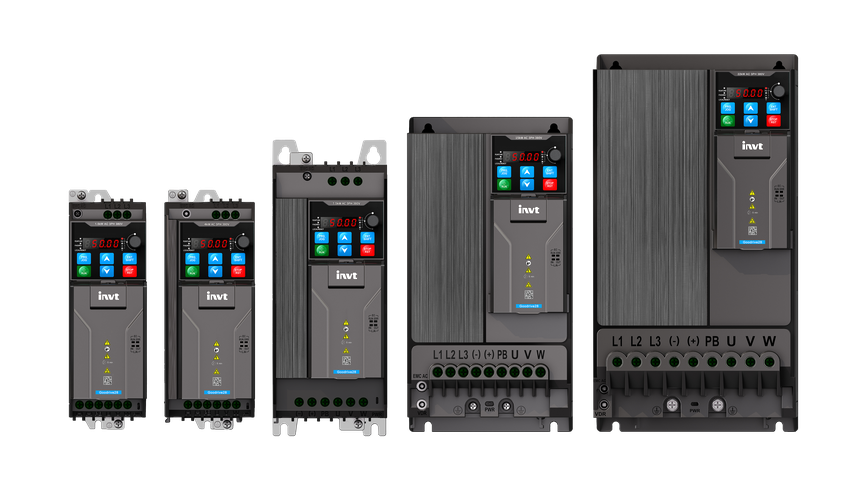
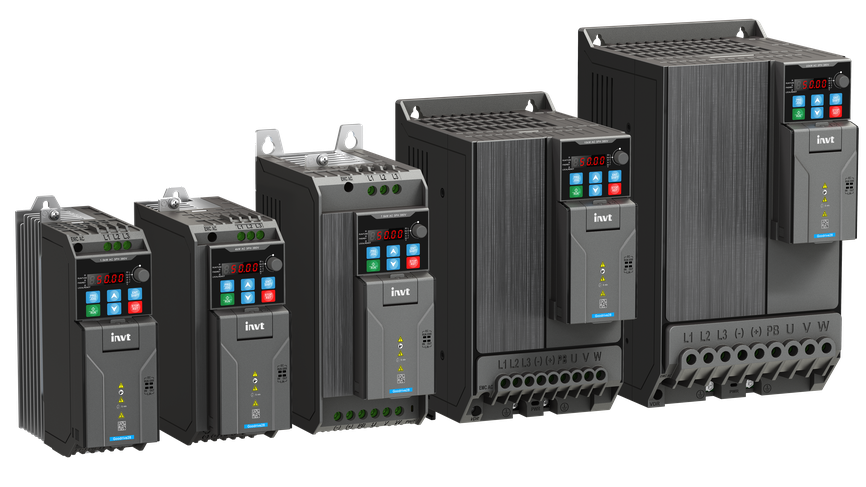
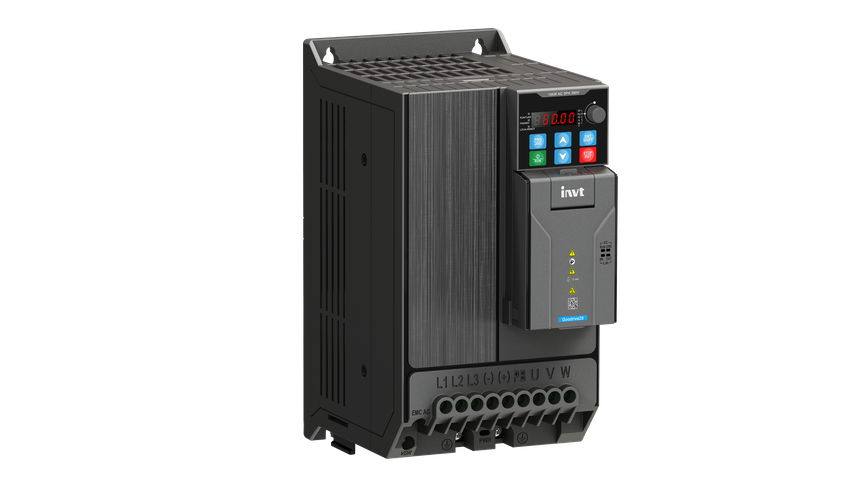
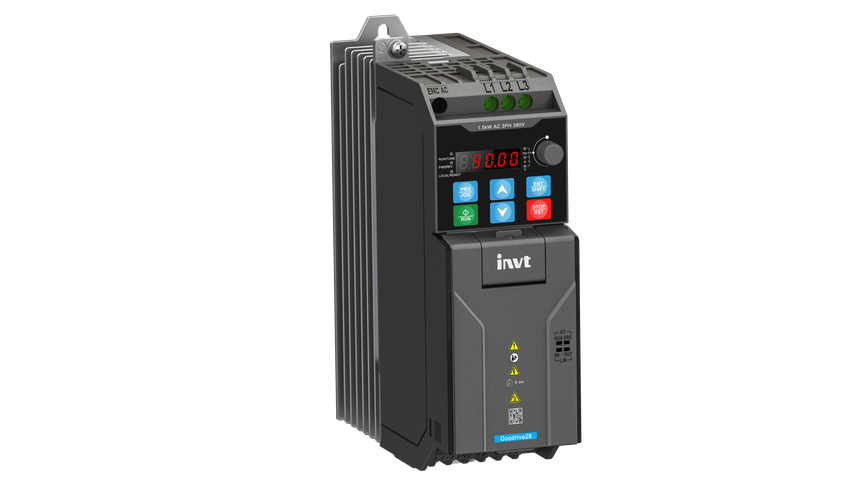
The GD28 series flexible general-purpose Variable Frequency Drive (VFD) is an intelligent VFD from INVT, designed for the mechanical drive market. It combines high performance, a compact design, and comprehensive functions. Certified to international standards such as CE and UL, it features built-in STO (SIL3) safety functions and an EMC filter. It is also equipped with a Type-C commissioning interface, supports energy-saving control, and is compatible with multiple industrial communication protocols, delivering excellent stability, intelligent performance, and cost-effectiveness. It is suitable for a wide range of industries including machine tools, textiles, printing and packaging, food, lithium batteries, logistics, 3C, rubber and plastics, cables, HVAC, and more, providing efficient and reliable motor drive solutions.
·0.2-22kW
·STO (SIL3), EMC filter
·CE, UL, and EAC certified


 Video
 Images
Overview
Features
Specifications
Downloads
More Resources
Case
Videos
More
Features

Powerful and versatile
 Supports normal- and heavy-duty operation for flexible adaptation to diverse conditions.Built-in braking unit across the entire series, reducing the need for external braking devices and lowering system costs.Supports motor temperature monitoring with PTC, PT100, and other sensors for real-time motor protection.Standard Modbus RTU, with an optional all-in-one bus communication expansion card supporting Profinet, EtherCAT, EtherNet/IP, and Modbus TCP.
01
Easy to use and efficient to commission
Standard Type-C port for direct PC connection, enabling fast parameter setting, copying, and monitoring.Standard LED membrane keypad; optional external LED or LCD keypads.Screwless spring-loaded terminals improve wiring efficiency by 50%. Supports seamless side-by-side installation, allowing for substantial reduction of cabinet space.02
Superior, stable, and efficient
Compatible with induction motors and permanent magnet synchronous motors; supports V/F and sensorless vector control (SVC).Intelligent energy-saving control minimizes motor losses under light load conditions, lowering operating costs. Fast speed tracking enables impact-free startup, improving efficiency and reducing downtime.03
Safe, reliable, and compliant with international standards
Built-in STO (SIL 3) prevents unintended startup to ensure operational safety.Built-in C3 filter effectively suppresses EMC interference, eliminating the need for external filters.Features strong environmental adaptability, supporting full-load operation at temperatures up to 50°C; the PCB conformal coating complies with 3C2/3S2 standards.Holds international certifications such as CE and UL, meeting market access requirements across multiple global regions.04
Specifications
Downloads
By Type:
 Load More

Have questions or need support?
Our professional team is here to help.


Inquiry
TOP
Popular Searches:
Repair Progress Tracking | Identity Verification
To protect your repair information, please verify using the mobile number reserved on the service order.
Verify with the reserved mobile number
Verify
SMS Verification Code *
If you cannot receive the code, please contact the after-sales hotline. 400-700-9997


Contact INVT
Get in touch with INVT. Our team will get back to you shortly.
Full Name *
Company Name *
Email Address *
Phone Number *
Country *
City
Inquiry Type *
Product Category *
Select the product you're interested in.
-
Industrial Automation
-
Network Power
-
PV & ESS
-
e-Mobility
Your Message / Requirements *
I have read and agree to INVT Privacy Policy and Terms of Use
Captcha *