Item | Specifications | |
Input and output | Input voltage | AC400V±15% |
| Input frequency | 47~63Hz | |
| Output voltage (V) | 0–Input voltage (V) | |
| Output frequency (Hz) | 0–400Hz | |
Elevator basic features | Maximum floors | 64 floors |
| Maximum running speed | 6m/s | |
| Group-control ability | Maximum 8 elevators | |
| Communication mode | 2 sets of CANbus communication ports, 2 sets of Modbus communication ports | |
Technical Performance | Control mode | PG vector control |
| Overload capability | 60s for 150% overcurrent; 10s for 180% overcurrent | |
| Starting torque response | PG vector control:0Hz/150% | |
| Speed control accuracy | PG vector control:±0.1% max speed | |
| Carrier frequency | 1.0kHz~16.0kHz | |
Peripheral interface | Low-voltage digital input terminals | 26 low-voltage digital input channels, DC24V / 4.5–8mA. The input mode (active low or active high) can be selected via the PW DIP switch. |
| High-voltage detection input terminals | 5 high-voltage detection input channels, AC/DC 110V | |
| Digital output terminals | 6 digital output channels, DC30V / 5A, AC250V / 5A. Among them, Y3–Y6 support multifunction output settings via parameters F0_70 / F0_71 | |
| CAN communication ports | 2 independent CAN communication ports | |
| Encoder interfaces | Built-in encoder interfaces supporting sine-cosine, open-collector NPN output, and push-pull output. Expandable support for EnDat encoders, UVW encoders, and resolver interfaces | |
Features | Operation mode | Normal run, inspection, re-leveling, door-open re-leveling, UPS operation, and hoistway self-learning |
| Stopping method | Distance-based stopping principle, with real-time generation of the travel curve for direct and precise leveling. | |
| Starting torque compensation | Two independent regulation methods using the speed loop and position loop, enabling smooth start without a load weighing device. | |
| Motor auto-tuning | Synchronous motors use load-based rotational auto-tuning, while asynchronous motors use static auto-tuning | |
| Hoistway auto-tuning | Accurately records floor positions and forced deceleration switch positions | |
| Automatic voltage regulation | Maintains constant output voltage automatically when grid voltage fluctuates | |
Operating and monitoring | Operator keypad | Composed of a 5-digit LED display, 8 indicator LEDs, and 5 keys. It supports fault inquiry, call commands, motor auto-tuning, hoistway self-learning, and test operations. For details, refer to Section 8.5. |
| Handheld operator | Supports parameter setting, parameter upload and download, soft fault inquiry, and manual call operations | |
| APP Easy-Commissioning software | Supports parameter setting, parameter upload and download, fault inquiry, and manual call operations | |
Popular Searches:

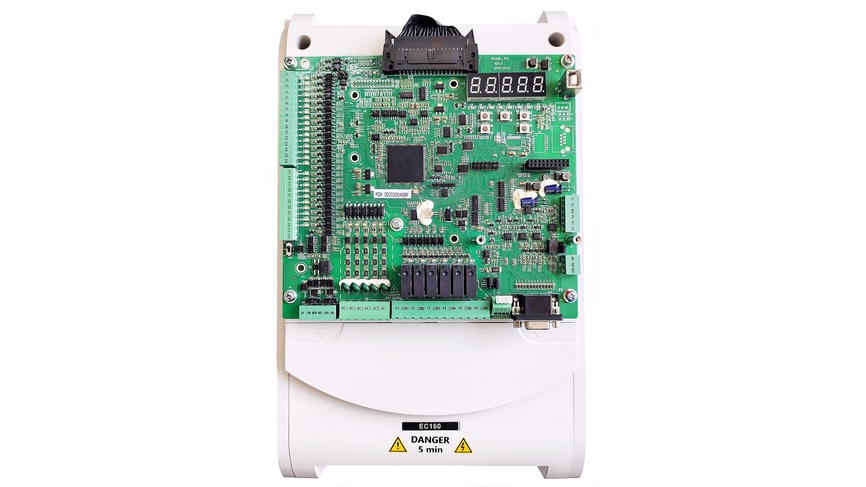
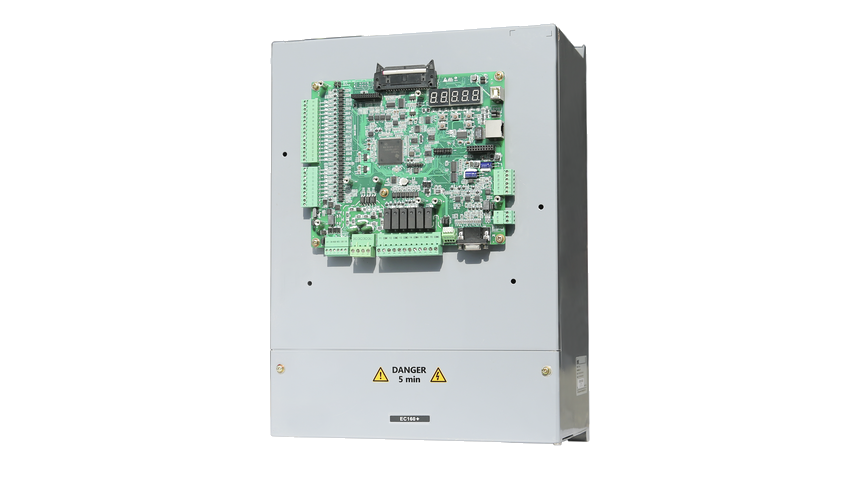
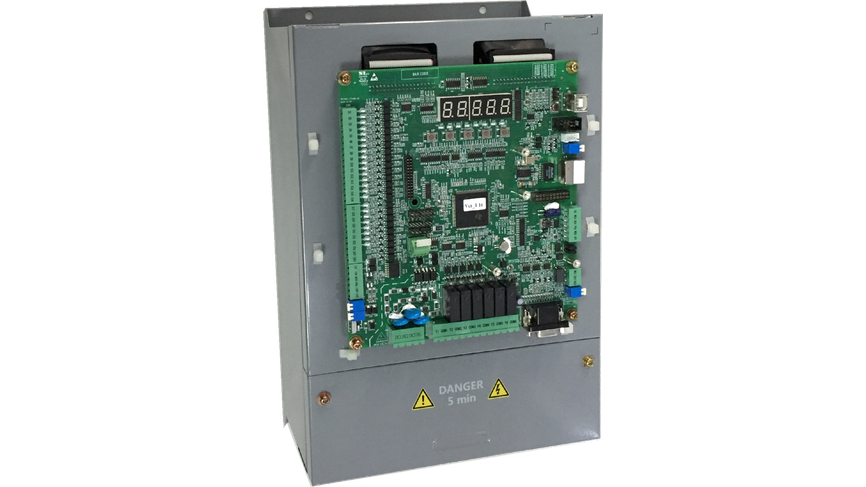
EC160A Elevator Intelligent Integrated Controller
The EC160A Elevator Intelligent Integrated controller is a new generation of intelligent elevator control system that integrates drive technology, control technology, and network communication technology in its design concept. Its highly integrated and simplified features make it widely used in escalators and moving walkways in public places such as shopping malls, subways, and airports.
·2.2-55kW
·
64 maximum floors
·
6m/s maximum speed


 Images
Overview
Features
Specifications
Downloads
More Resources
Case
Videos
More
Features

Safe and reliable
 Designed in strict compliance with IEC standards and ISO 14001 environmental management system, and certified by the EU-accredited TÜV agency with TUV-CE and EMC directive approvals. Static component certification and multiple layers of safety protection ensure full compliance with EN 81 and GB/T 7588 safety standards.Features include automatic car position correction, forced deceleration switch monitoring, overtravel and bottoming protection, built-in oscilloscope circuitry, data black box,
and base-floor interlock functionality.Redundant safety design significantly enhances overall elevator safety
01
Ease of use
Elevator-specialized integrated design with
simplified wiring and easy commissioning.Equipped with built-in digital display and control keys; supports handheld operator, PC-based commissioning software, and APP-based control.Full CAN serial communication for high-speed, reliable data transmission (optional RS485 communication for hall call displays).Integrated control and drive system with compact structure, ideal for small machine room cabinet installations.02
Intelligent high performance
Supports intelligent, networked group control with built-in IoT interfaces for smart IoT platform integration.Auto-adjusted carrier frequency based on load characteristics.Advanced load-sensorless start compensation technology.Compatible with both synchronous and asynchronous motors, featuring static and dynamic auto-tuning.Distance-based direct landing technology, with automatic generation of N-curves for smooth, stepless speed control.03
Distinctive functions
Emergency rescue function under single-phase AC220V power (cost-effective solution); Maintenance functions; Self-adaptive current loop auto-tuning; Independent adjustment for leveling precision; Adaptive physical layer for hall call board; Intelligent brake force detection. Door logic self-learning, door lock short-circuit self-detection, and more.04
Specifications
Downloads
By Type:
 Load More

Have questions or need support?
Our professional team is here to help.


Inquiry
TOP
Popular Searches:
Repair Progress Tracking | Identity Verification
To protect your repair information, please verify using the mobile number reserved on the service order.
Verify with the reserved mobile number
Verify
SMS Verification Code *
If you cannot receive the code, please contact the after-sales hotline. 400-700-9997


Contact INVT
Get in touch with INVT. Our team will get back to you shortly.
Full Name *
Company Name *
Email Address *
Phone Number *
Country *
City
Inquiry Type *
Product Category *
Select the product you're interested in.
-
Industrial Automation
-
Network Power
-
PV & ESS
-
e-Mobility
Your Message / Requirements *
I have read and agree to INVT Privacy Policy and Terms of Use
Captcha *